The significance of
tail worship Lord Hanuman
-Santhipriya-
Who is Lord Hanuman?
Lord Hanuman, in one interpretation is claimed to be the incarnate or reflection of Lord Shiva, while some claim him to be incarnate of Lord Vishnu, or the son of Lord Vayu, the god of wind. Most of the narrations on Lord Hanuman is derived from puranic scripts.
There is a puranic story on the manifestation of Lord Hanuman. Once Narad Muni’s face was discreetly changed to resemble that of a monkey for fun by Lord Vishnu. Blind to the change in face, when Narad Muni went to a function, he was ridiculed by every one. He saw his reflection in a pool of water and was shocked to see a monkey’s face. Humiliated Narad Muni, cursed Lord Vishnu in anger, that the Lord would have to depend upon a monkey to save his life in one of his births. All acts of divine are per-scripted to certain plan and therefore when Lord Vishnu manifested as Lord Ram, Lord Hanuman too manifested as monkey God to help him.
The second story is the more widely accepted one. According to legend, Lord Hanuman’s mother Anjana, who was half-monkey, half human, prayed to God for a son while King Dasaratha too was in penance for the same cause. Pleased with the prayers of King Dasaratha, God sent heavenly blessed food to share between his three wives for birth of sons to them. At the same time appreciating the prayer of Anjana, some quantity of the same heavenly blessed food was also given to her through Lord Vayu. Anjana, who ate the blessed food delivered a baby boy, who was Lord Hanuman. Lord Hanuman born in the form of a monkey like his mother Anjana, was adapted by Lord Vayu as his own son out of compassion. Thus, Lord Hanuman became the son of Lord Vayu.
Lord Hanuman mainly manifested to help Lord Ram when he waged war against demon King Ravan to rescue his abducted wife Goddess Sita; the importance, strength and the power which Lord Hanuman possessed came to light only during the Lankan war when Lord Rama waged war against Ravan.
Once the war ended, when Lord Ram revealed his plan to exit the universe, Lord Hanuman requested that he be allowed to remain on earth as long as Lord Rama’s name was venerated by people as he desired to hear people chanting the name of Lord Rama. Overwhelmed by the request of Lord Hanuman, Lord Rama acceded to his wish and said that he (Lord Hanuman) should sit in meditative form in several temples in the universe to silently listen and enjoy people chanting his (Lord Rama) name.
How did Lord Hanuman derive extraordinary strength?
During Ramayan war, each one of the divines gave a part of their extraordinary powers to Lord Hanuman. Lord Brahma bestowed power to induce fear in the minds of those opposed to him besides ability to transform into bigger or smaller form in wink of an eye; Lord Shiva gave shield to protect him and power to cross ocean or any other places like mountains with ease; Lord Indira gave Vajrayuda; Lord Varuna offered protection from any kind of threat from water and Agni blessed that fire will not harm Lord Hanuman in any manner.
When Lord Hanuman’s tail was set on fire by the demonic forces of King Ravan, Lord Agni freed him from feeling the heat of the fire. Further Lord Agni bestowed special powers to stretch or shrink his tail to any length and to lift anything by his tail, weight immaterial. The Navagrahas stayed inside his tail to ensure that no malefic effects befell on Lord Hanuman. Thus, Lord Hanuman’s tail was insulated with the extraordinary powers bestowed by several divine forces and became the most powerful organ in his body.
Lord Hanuman also received several boons from divines like Lord Kuber, Lord Surya, and Lord Yama and from Goddess Sita as well, all of which made Lord Hanuman literally invincible and unconquerable.
Lord Hanuman took Panchamuha form to defeat a formidable rakshasa named Mahi Ravana (also called Mayil Ravana and Ahi Ravana in south), known for his dark magic and sorcery. During the Lankan war waged by Lord Rama to rescue his wife, the demon King Mahi Ravana abducted both Lord Rama and Lord Lakshmana in the midst of the war and hid them in the Pathal loga which was beneath seven lower worlds called netherworld that are inhabited by various entities like Nagas (serpent beings), Daityas, and Danavas (demons). The Daityas and Danavas are two significant clans of powerful supernatural beings. They both trace their origins to the sage Kashyapa, but born through different wives. They are often associated with Asuras, who oppose the celestial forces in their quest for dominance. The seven levels of netherworld are generally Atala, Vitala, Sutala, Talatala, Mahatala, Rasatala, and Patala Logas.
The life force of Mahi Ravana (also called Mayil Ravana in south and as Ahi Ravana elsewhere) was hidden in five bugs in five different directions, and it was destined that Mahi Ravana would meet death only when all the five bugs were killed at the same time. To overcome Mahi Ravana, whose life lay in five bugs hidden in different directions, Lord Hanuman had to act in all directions simultaneously and at once. The five faces of Lord Hanuman enabled him to track all those five bugs at once and kill them after waging fierce battle with Mahi Ravana in pathal loga to get Lord Rama and Lord Lakshmana freed. Some folklore also suggest that the life of Mahi Ravana was in the form of five burning lamps (instead of five bugs) which were to be lighted off simultaneously to end the life of Mahi Ravana. The Panchamuha – five faces- aspect of Hanuman was thus born.
Though this story is not universally accepted as puranic text, it is told in the form of word-of-mouth folklore; however, it provides an explanation why Hanuman assumed five faces to vanquish the demon king. Because of this, the Panchamuha roopa of Hanuman is considered a tantric aspect.
How did Lord Hanuman get bell tied to his tail?
Lord Hanuman received the bell tied to his tail as a symbol of his strength and devotion. According to a folk tale, Lord Mahavishnu, disguised as Lord Ram, appeared before Lord Hanuman and advised him to transfer his powers into a small bell. By tying it to his tail, devotees could ring the bell and pray for his blessings. The melodious sound of the bell would harmonize with the chanting of Lord Rama’s name, ensuring it wouldn’t disturb Lord Hanuman.
Perhaps the ringing of the bell in a temple to invoke the blessings of God began only based on this story, since, prior to this incident none of the puranic texts referred to any kind of bell connected to the temples. As per another folk lore, after Lanka battle, some of Rama’s monkey soldiers were found missing. Lord Ram discovered them struck beneath a massive bell that fell during the fighting. When Hanuman tied his tail to the bell and lifted it to rescue them, the sound of the bell released the chant of Sri Ram while ringing. Thereafter the bell got struck to the tail of Lord Hanuman and refused to come out.
Worship of Softer and Fierce forms divines
Before we explain the significance of tail worship of Lord Hanuman, let us also understand the kinds of worship prevalent in hindu tradition and the easier form of worship to any divine which can be pursued by an individual pursuing family life. It is common knowledge that the divines are mostly worshipped seeking some kind of favour for self or their family.
There are two kinds of worship, the first being the idol worship or vigraha aradhana or idolatry or image worship to the yanthras and symbols, idols made of mud, stone, metal or wood etc and to some extent framed pictures of specific divines. Again, the idol worship involves both worship to fierce forms of divines and gentle divines. Worship of fierce forms of deities, known as ugra (fierce) or krodha (anger) forms in vigraha aradhana needs specific rituals and are often associated with tantric practices or particular sadhanas. The fierce forms of divines are those with weapons, wearing garland made of skulls, carrying bird bat in hand, dead man under their feet, Goddess with bulging bloodshot eyes with protruding tongue, huge breast and masculine in nature and various yanthras to those forms of divines, Kali with blood dripping from her sword or tongue, Lord Narasimha killing Hiranyakashibu, Lord Hayagreeva in ferocious form, Goddess Mahishasuramardini annihilating a demon, Goddess Prathyangira, Lord Kalabairava etc are some examples to quote These divines represent the protective, transformative, and destructive aspects though encompass both soft and frightening aspects in the entire spectrum of existence. They are the most important upasana deities of our Guru Parampara and need to be worshiped with stricter norms to get the desires fulfilled.
Therefore, due to the intensity of the energies involved in invoking them, it is considered crucial to perform the rituals under the guidance of only an experienced guru or priest who understands the nuances and safety protocols. Chanting the bija (seed) mantras and performing elaborate rituals to invoke and appease the deity without incurring negative consequences is not easy to perform by those in the family life as improper worship of these deities lead to negative outcomes; unguided worship or pooja performed at home for fierce forms of devathas-whether in idol form or to their pictures could be considered dangerous and is actively discouraged.
Our shastras stipulate keeping only calm and gentle deities mainly those with spouses like Lord Rama and Sita, Lord Siva and Parvathi, Lord Muruga with Valli and Teyvanai, Lord Vishnu with Lakshmi, Lord Narasimma with Lakshmi, Lord Ganesha, Goddess Saraswathi, Goddess Lakshmi, Lord Krishna with holy cow, Lord Dattathreya with his cow and accompanying animals, Venkatachalapathi, humble Lord Hanuman kneeled before Lord Ram or Lord Siva or even standing alone with words Rama inscribed all over, Lord Hanuman carrying Sanjivani mountain, or group of deities in the posture of Pattabishegam (coronation) etc . Therefore, it has always been suggested to worship divines of gentle nature or perform deepa worship with lighted oil lamp and seek favors from them, which can be performed by any ordinary individual without the aid of a guru or teacher.
Universally Lord Hanuman is worshiped in temples and in prayer halls (pooja room) in private houses. The most common form of worship is the tail worship of Lord Hanuman, who appear either in sitting or standing posture.
There is significant difference between worshiping gentle form of Lord Hanuman and the one appear with weapons. Most of us work with the darkest internal and external forces, hence, the pundits say that even worshiping Panchamuga Hanuman at home without proper rituals will bring negative results and be avoided where as the tail worship of softer form of Lord Hanuman is actively encouraged.
Though Lord Panchamuga Hanuman promises security to all devotees and fulfill the prayers, he cannot be offered worship in the normal manner since Lord Panchamuga Hanuman is one of the most important upasana deities of our Guru Parampara and is in ugraha form in that posture carrying arms in hands. Lord Panchamuga Anjaneya can be offered worship only in his temples as the pooja is performed observing certain norms and rituals in strict discipline there.
What is the significance of tail worship of Lord Hanuman?
Lord Ram stated that those who desire to get their wishes fulfilled, should offer pooja to the tail of Lord Hanuman and at the conclusion of the ritual, when the bell attached to the tail of Lord Hanuman is rung (when the mark of vermillion dot is placed over the tail, it will raise the sound of bell) he will open his eyes and grant them the boon desired. This symbolizes his limitless energy, agility, and spiritual strength.
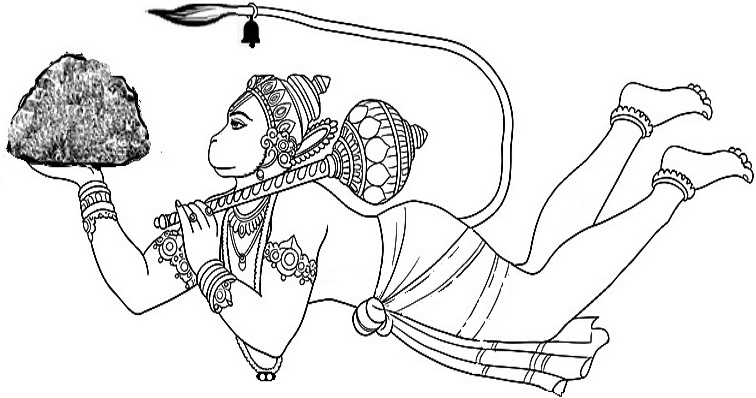
This is the reason why the 48 days of ritualistic pooja is performed to the tail of Lord Hanuman. The pooja ritual of 48 days is performed keeping the pictures of Lord Hanuman in which he appear flying in the air with Sanjeevi Mountain in one hand or seated before Lord Ram or offering prayers to Lord Shiva or seated in meditation before Shiva Ling. However, the tail worship of Lord Hanuman is far different from other poojas or rituals.
Opinions over the worship of Lord Hanuman, the bachelor God, too are many; some say that excessive worship of Lord Hanuman lead to the married couples to remain detached from family life; some say bachelors who perform ritualistic worship of Lord Hanuman may be less inclined to marry, while another opinion negates both the contentions to tell that bachelors should actually engage in Lord Hanuman’s ritualistic worship for self discipline and mental strength.
The tail worship of Lord Hanuman holds great significance because it embodies various divine powers. By praying to the tail, devotees connect with the powers of multiple deities contained within it. Therefore, the worship of Lord Hanuman’s tail is twin fold- pay respect not only to Lord Hanuman, but also to these divine forces seeking relief and blessings of them through Lord Hanuman.
What are the specific causes for which the tail worship of Lord Hanuman is done?
1. To get rid of evil forces haunting the worshipper
2. To get rid of the malefic effects on account of curses, jealousy, evil eyes and black magic
3. To get specific prayer answered
4. To get rid of navagraha doshas, especially doshas from 7½ years Lord Sani
5. For success in education, career, want of wisdom, fame
6. To gain courage and strength to defeat the inimical forces etc
7. To remove unnecessary hurdles
8. For spiritual development
9. End discord between husband and wife
How is the tail worship done?
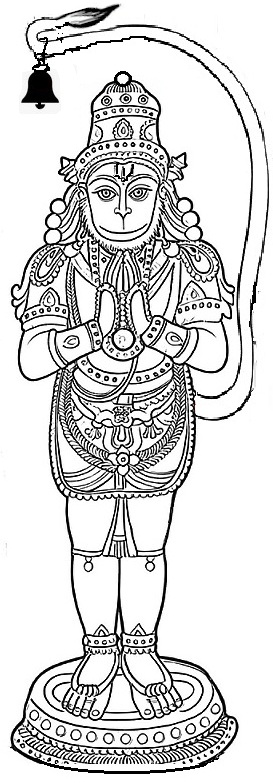
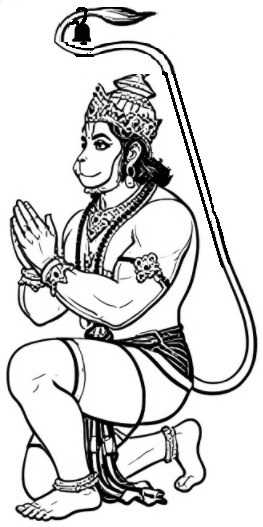
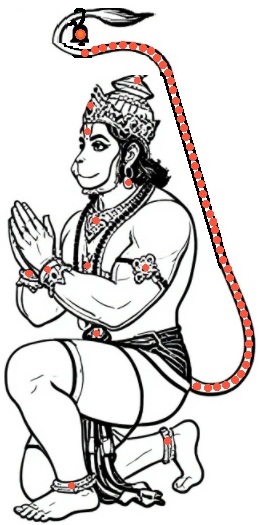
1. Use a picture of Lord Hanuman with his tail raised above his head and in shape as shown above, ideally tied with a bell at the end of the tail.
2. Take bath in the morning.
3. Use vermilion or Sindoor paste for courage, Cinnabar called Kumkum for general wishes, or butter for wisdom/career to put the dot over the tail.Apply a dot with butter and then put a small dot over it with vermilion powder.
4. Start applying one dot per day over the tail with one of the above materials.
5. Put a small dot over the tail beginning from the bottom of the tail touching the body of the Lord Hanuman. (See the illustration shown below under 16) and move upwards with dots put the subsequent days.
6. Only one dot to be put a day.
7. After putting the mark chant the following Hanuman Gayathri mantra ten times.
Om Anjaneya Vidmahe
Vaayu Puthraya Dhimahi
Thanno Hanumanth Prachothayaath
ॐ आंजनेय विद्महे
वायु पुत्राय धीमहि
थन्नो हनुमंत प्रचोथयथ
8. After chanting, pray to the Lord for the success of your prayer, prostrate before the photo to offer respect.
9. Continue the prayer and chant for 48 days putting only one dot a day, with either Vermillion, Sindoor or Butter.
10. Do not put the dot over the previous dot, but fresh dot above the previously placed dot as shown in the illustration.
11. Once you reach the end day of the ritual (48th day) you would have reached the tail end where the bell has been tied.
12. Even before the end of the 48th day, if putting the dots has reached the tail end, do not feel worried. Continue to put the dots over the last dot – dot over dot- for the remaining days till the period of penance gets over. This is permitted.
13. Finally, after placing the last Sindoor dot at the end of the tail on the 48th day, do not fail to put the Sindoor on the bell tied to the tail. By doing this you are ringing the bell and awakening the meditating Lord Hanuman to bless you and answer your prayer positively.
14. It is preferable to begin the Tail Pooja either on a Tuesday or on Saturday. During the mensural periods of the ladies, if continuity of putting dot becomes the problem, someone else in the family can continue to do it during the period of their absence. However, on 48th day, it is necessary that the one who began the prayer should only end it by themselves. Therefore, the ladies are advised to begin the tail Pooja in such a manner that they are available without mensural problem to conclude it on the 48th day.
15. On 48th day, once the process of applying last dot on uppermost end of the tail is completed, some prasad is offered to him in the name of oblation to complete the prayer. The offer can be even a glass of simple milk added with sugar or Lord Hanuman’s favourite foods like butter, vadas (without onion/garlic), or betel leaf garlands or garland made of Vada and complete the ritual.
16. Till you decide to perform tail pooja again, even if it is few months later, do not wipe out the dots placed over the Lord. Retain them on the framed photo.
17. As proper picture of Lord Hanuman to perform tail worship is not freely available, get the print out of the pictures reproduced in next two pages, frame it and use it for tail pooja.