
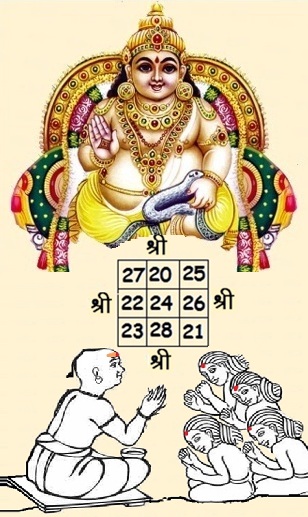
In September, 2010, I published an article on Yanthra Pooja of Lord Guber, based on insights from a temple pundit in Kumbakonam. Many readers requested clarifications on the Guber Yanthra Pooja, and I responded to each of them individually. Therefore, I am reposting the revised version of the same article with newer illustrations without changing the basic contents. This Guber Yanthra Pooja is simple, yet highly beneficial for receiving Lord Guber’s blessings. The original article posted in the year 2010 has since been removed.Performing Guber Yanthra Pooja can enhance wealth, transform losses into gains, and bring peace at home with the blessings of Lord Guber, the God of wealth. This Yantra was given to Lord Guber by Goddess Mahalakshmi after he lost his wealth and mental strength due to a curse incurred by him. Performing Guber Yanthra Pooja two or three times a year is sure to boost prosperity and promote harmony and happiness at home.The Guber Yanthra Pooja is free from complex chants of sanskritised mantras and procedures, but needs only commitment, dedication, faith and sincerity to achieve the end result for which it is performed.
What you require for the Guber Yanthra Pooja is nine coins of the same size and value; the value of the coin is unimportant, it should be legal tender issued by the govt. Do not use commercial coins available in the market which appear like legal tender or the coins withdrawn from public use by the treasury.
You need to start the nine-day Guber Yanthra Pooja either on Friday or a Full moon day. For example, if you choose to start it on a Friday, you have to do the Guber Yanthra Pooja every Friday for nine weeks in a row without skipping any. If you choose to begin Guber Yanthra Pooja on a Full moon day, which is actually most auspicious and better option, you should continue the Guber Yanthra Pooja for the next nine Full moon days. It’s really important that there is no interruption or a break in the nine days Guber Yanthra Pooja performed in a row. If, for some reason, you cannot perform it, don’t worry, it is permissible for any other family member specifically wife, husband, daughter, or son, daughter in law to assume responsibility for its completion. However, the son in law should not do the Guber Yanthra Pooja for you.
Procedure to perform the Guber Yanthra Pooja:
1.Take a morning bath, draw a small floral design (Rangoli) with white rice powder in front of the deities in your pooja room or below the shelves where you offer worship to the divines.
2.Sit in front of it, draw Guber yanthra over the floor or dark coloured wooden board, whichever you choose. Do not use a commercially available stencil for drawing the Guber Yanthra; it should be drawn by your own hand; it need not be perfect, but the numbers like 27, 20, 25, and the word ‘Shree’ should be just readable.
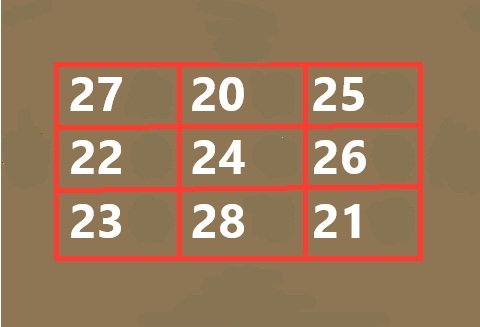
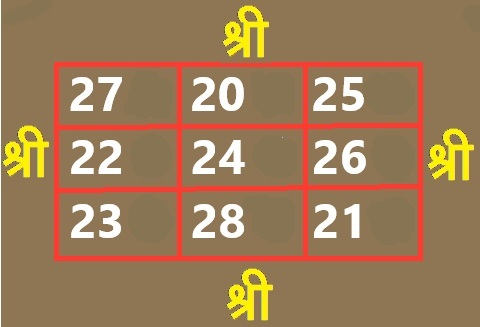
3. Use pure rice powder, white in colour for the numerals, red Vermilion powder (which is applied on the forehead of married ladies) for the dividing lines (Table) and the yellow turmeric powder or sandal powder / paste for putting the letter ‘Shree’ on all four sides. Place one coin on each side of the numerical in all the nine boxes.
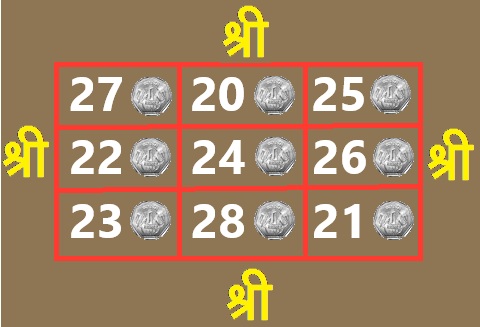
4.It is important that you use coins of the same value for use on all the nine days; they can be Re 1, Re 5, or Re 10 coins.
5.How do you perform Pooja? Very simple. After you draw the Guber Yanthra as described, in front of the Yanthra, light up an oil lamp filled with pure Gingili oil or pure Ghee. Do not use any other oil.
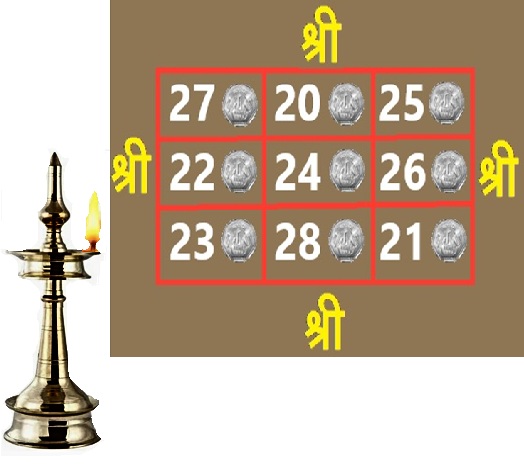
6. Begin chanting the following nine prayers, nine times in a row, commencing from prayer to Lord Vinayaga seeking his blessings for successful completion of the ritual undertaken.
7. Prayer:
i. Oh, Lord Vinayaga, I salute thee, bless me to beget the blessings of mother Mahalakshmi, through Lord Guber who is in the form of the Guber Yanthra here. I seek your blessings for fulfillment of my prayers and completion of the Guber Yanthra Pooja successfully.
ii. Oh, mother Mahalakshmi, I salute thee through Lord Guber in the form of this Yanthra and request both of you to give me enough wealth to wipe off my debts.
iii. Oh, Mahalakshmi, I salute thee through Lord Guber in the form of this Yanthra and request both of you to give me enough wealth to run my family .
iv. Oh, Mahalakshmi, I salute thee through Lord Guber in the form of this Yanthra and request both of you to give me enough wealth to impart education to my children.
v. Oh, Mahalakshmi, I salute thee through Lord Guber in the form of this Yanthra and request both of you to bestow blessings to retain the wealth which gets drained off unnecessarily.
vi. Oh, Mahalakshmi, I salute thee through Lord Guber in the form of this Yanthra and request both of you to give me to bestow your blessings to recover my losses in my life.
vii. Oh, Mahalakshmi, I salute thee through Lord Guber in the form of this Yanthra and request both of you to stay with me forever and grant prosperity.
viii. Oh, Mahalakshmi, I salute thee through Lord Guber in the form of this Yanthra and request both of you to give me mental peace and happiness.
ix. Oh, mother Mahalakshmi, I salute thee through Lord Guber in the form of this Yanthra and request both of you to fulfill my prayer.
8.After completion of one round of chant (i to ix), place a small flower over one coin beginning from top left ie 27 followed with 20, 25, 22, 24, 26, 23, 28, and ending on 21. Thus you would have placed nine flowers over nine coins at the end of chanting the entire prayer (i to ix), nine times in a row.
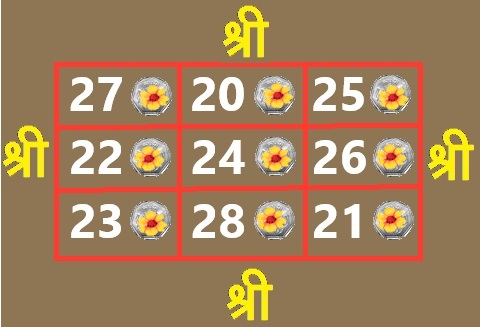
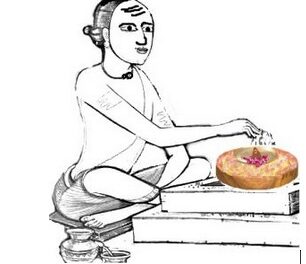
9.If you cannot procure flowers, then sprinkle Vermilion powder called Kunkum (which is applied on the forehead of married ladies) and sandal powder. See illustration below. Ensure that while placing the flower, they do not erase the numerals.
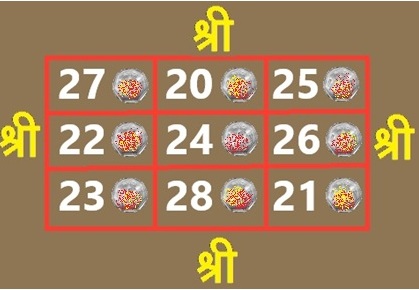
10. Once you have completed chanting the prayer for nine times and offered flowers or sprinkled vermilion powder to the coin, light up camphor in a lamp holder and offer it to the Guber Yanthra by circling around it. Take three circles with the lamp.
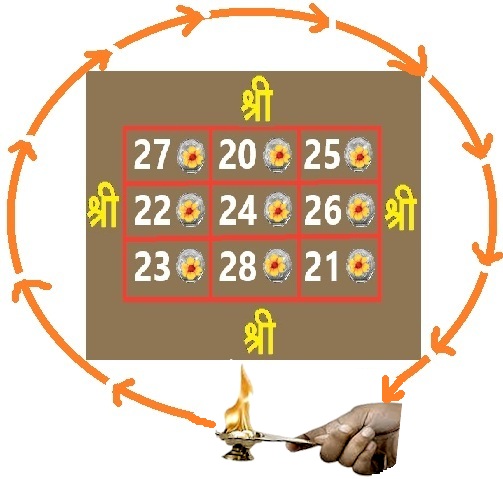
11.This act of circling around the Guber Yanthra with camphor lit lamp symbolizes the act of burning the negative energies with the power of the Guber Yanthra so that Goddess Lakshmi and Lord Guber who enters your home through the Guber Yanthra will feel comfortable to stay there.
12. Once the day’s Guber Yanthra Pooja is completed, prostrate before yanthra, allow the lamp to light off itself and leave everything remain undisturbed on the day of the ritual.
13.Next day after taking a bath, take out the coins and keep it safe for use on the second day (next week) of the Guber Yanthra Pooja. Be aware that the same nine coins used on the first day’s Pooja is to be used on all the nine days of Guber Yanthra Pooja.
14.The Guber yanthra drawn should be carefully wiped out from the floor or the board for use next week. Every week fresh Guber Yanthra had to be drawn for the Guber Yanthra Pooja.
15. The prayers may be kept typed or hand written and read since only the same prayer is to be chanted for all nine days of the Guber Yanthra Pooja.
16. After completion of the nine days Guber Yanthra Pooja, all the coins may be collected and kept separately in your cash box at home after wiping it clean with water. Do not spend it or mix with other coins. When you decide to perform the same Guber Yanthra Pooja next time, the same coins should be used in the Guber Yanthra Pooja.
17.Do not use a broom to clean the yanthra. Wipe it with a cloth, then clean the area again with a wet cloth. Once it is dry, you can use a broom to clean the home.
18. If Guber Yanthra Pooja is continued to be performed regularly say twice or thrice a year in the family, it will show a miraculous effect by way of ending unwanted expenditures, removal of tensions from the minds of family members and give sense of natural happiness.
19.On the ninth day after completion of Guber Yanthra Pooja, the one who had performed the Guber Yanthra Pooja must visit the temple of Goddess Lakshmi, repeat the same prayer once, and seek her blessings, else they can go to any temple and pray in the sanctum of Goddess Lakshmi. If there was no separate sanctum for Goddess Lakshmi, go to the sanctum of Goddess Para Sakthi (Goddess Parvathi called Ambal) and offer the same prayer to her, mentally visualizing her as Goddess Lakshmi. This is because Goddess Lakshmi is also an incarnation of Goddess Para Sakthi only.
While performing the Guber Pooja which side should the performer face ?
The Guber Pooja should be performed by the devotees facing North as Lord Guber is the authority on North side.
Though Goddess Lakshmi is the giver of wealth, why should one worship Lord Guber instead? What is the significance of this?
While Lord Shiva chose Goddess Mahalakshmi to give wealth, simultaneously he appointed Lord Guber to help her monitor and maintain accounts of her treasures. Lord Guber lives in an abode called Alakapuram, a city in the Himalayas. Even if Goddess Mahalakshmi wants to give wealth to someone who prays to her, Lord Guber can stop her by drawing her attention over the sins of the seeker. Because they work together in granting wealth, it’s important to please Lord Guber to receive blessings from Goddess Mahalakshmi.
When Lord Shiva appointed both Goddess Lakshmi as giver of wealth and Lord Guber, her treasure house custodian, he also gave additional responsibilities of regulating Navanithis called Devaloga treasures. They are Padma Nithi, Maha Padmanithi, Maha Rapathmanithi, Katchapa Padmanithi, Kumuthanithi, Nandanithi, Sangunithi, Neelanithi and Yoganithi. However, in some puranas only eight Nithi omitting Yoganithi have been mentioned such as Padma, Mahapadma, Makara, Katchapa, Mukunda, Nandaka, Nila, and Shankha; the Nithis represent nine types of treasures for material and spiritual wealth. Nithis represent different kinds of wealth needed by one for prosperous and successful life; hence, Lord Guber himself occupies the nine blocks in the Guber Yanthra to bestow those nine Nithis.
Another lore in the Puranas sates that when Lord Guber lost entire wealth to Ravan he sought help from Goddess Lakshmi; she being compassionate, not only restored his wealth, but also appointed him the guardian of her treasure house. Therefore, people believe that unless Lord Guber opens up the treasure box, one may not gain wealth; hence, it is important that worship of Lord Guber along with Goddess Lakshmi is necessary while seeking wealth and happiness from Goddess Mahalakshmi.
The three most important treasures (Nithi) amongst them are
• Sangunithi, the conch shell, a sacred emblem of Vishnu, which leads one to attain bliss arising from self-realization.
• Padmanithi, which represents the lotus flower associated with wealth that can be dedicated to ascetics and celestial beings.
• Yoganithi, which refer to a person who attains spiritual wealth through yogic powers
As the guardian of the treasures of Pathal Loga, Bhoo Loga and Deva Loga, Lord Guber, releases the above said three Nithis which are represented in the nine blocks of Guber Yanthra.
Similarly, Goddess Lakshmi was empowered to take eight more secondary manifestations in the names of Ashta Lakshmi who bestows spiritual wealth; inner peace; liberation (moksha); financial prosperity; will power and strength; agricultural abundance; food; good health and sustenance; animal wealth; royal power; dignity; social status; fertility for offspring and family; family harmony; courage; valor to overcome obstacles, difficulties, and battles; knowledge; education; arts and sciences; wisdom; intellectual development; success and victory in all endeavors etc. The ‘Prosperous life’ includes all of them. Therefore, the Pooja ritual of Guber Yanthra helps to receive the blessings of Goddess Mahalakshmi for ‘prosperous life’.
How is Guber Yanthra considered to be distinctive from other Yanthra
Guber Yanthra is indeed different and distinct from other Yanthra. This powerful Yanthra comprises of nine squares.
Total up the numerals of any three boxes – sideways or top to bottom or even in cross direction, the total will lead to figure 9 only (72 i.e. 7 + 2 =9).
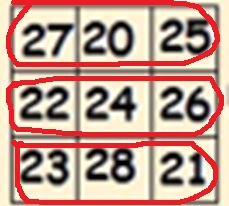
• 27+20+25=72 = 7+2=9
• 22+24+26 =72 =7+2=9
• 23+28+21=72 = 7+2=9
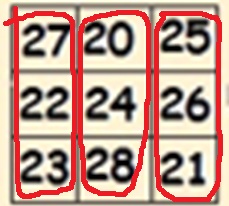
• 27+22+23 =72 =7+2=9
• 20+24+28 =72 =7+2=9
• 25+26+21 =72 =7+2=9
First diagonal
• 27+24+21 =72 =7+2=9
Second diagonal
• 23+24+25 =72=7+2=9
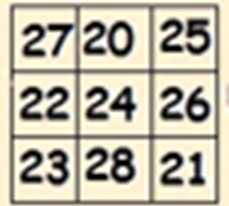
Total of all nos in all the nine boxes
• 27+20+25+22+24+26+23+28+21=216=2+1+6 =9
Now multiply the nos from all the boxes.
• 27 x 20 x 25 x 22 x 24 x 26 x 23 x 28 x 21= 780832483200 = 45 =9.
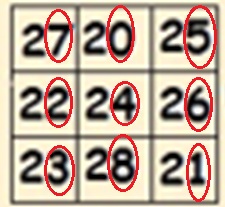
See another unique aspect – second no in each of the boxes. You will find Nos from 0 to 8. The zero is her real form-Goddess Mahalakshmi while the other eight are her secondary manifestations-Ashta Lakshmi. Thus, Goddess Mahalakshmi appears in nine forms in nine squares and bestow the total wealth needed for her devotees.
What is the philosophy of Guber Yanthra?
One can see figure 2 in each one of the boxes. Figure 2 represents oneness of Goddess Lakshmi and Lord Guber (1+1=2) in granting overall wealth and health.
This is why it is believed that by the powerful Guber Yanthra one will get enormous wealth from Goddess Mahalakshmi through Lord Guber. It is possible that the nos seen in each of the boxes may have been formulated based on Tantra and Mantra calculations which is not clear to us.
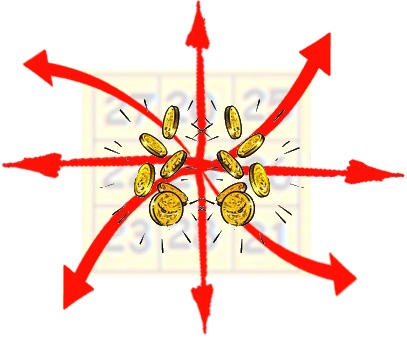
Seated in nine boxes they bestow wealth in all the eight directions (Ashta Disha).
The word Sree found on the four sides represents Goddess Parasakthi who resides in Sripuram in Himalayas along with Lord Shiva. Since the universe has been created and under the control of Paramathman which is Siva Sakthi, this Yanthra possesses abundant grace of Siva Sakthi.




Dear Jayaraman Sir
I am impressed by the wealth of your knowledge and willingness to share them. I do not see many other sources with those information.
Sadly I cannot read Tamil but I follow your English articles regularly. You had a seried of 8 articles on kuladevatha in English , which I cannot see any more.The article was very interesting and if you could re-publish or give me a link, it would be nice.