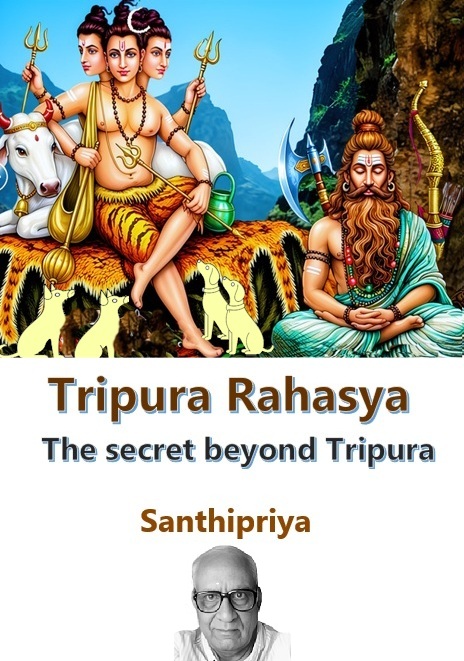
The Making of Tripura Rahasya: English version: A Journey Within
Few years back I attempted to write explanatory text on two spiritual books – the Ashtavakara Gita and the Tripura Rahasya. In order to understand the meanings in these two scriptures I read many books and commentaries, besides referring to other explanatory texts available on web. However, I was unable to fully comprehend any of the commentaries contained in them. I could neither connect with their interpretations nor clearly understood the profound truths they were trying to communicate.
Subsequently whenever I attempted to write explanatory texts on these scriptures, I had to withdraw, unable to continue beyond few verses. Eventually, I had to interpret my inability to write the explanatory text as a sign that Lord Dattathreya did not consider me worthy of undertaking such a sacred task and had therefore not graced me with the necessary understanding. With this thought, I abandoned my efforts and stopped even contemplating writing those books for next few years.
In the year 2022 or so, a group of devotees of the revered saint Ayya Vaikundar, based in Kanyakumari, approached me with a request to translate a book named Akilathirattu Ammanai—a poetic account of the life and teachings of their revered saint, Ayya Vaikundar, into simple, accessible Tamil and English languages. They assured me that there was no urgency and that I could take as much time as I needed to complete the work. The original text was written in poetic ballad style in Tamil in the distinctive dialect spoken in the southernmost districts of Tamil Nadu like Kanyakumari, Tirunelveli, and Thoothukudi districts. For a change I accepted the unusual and challenging work.
What initially seemed like an interesting assignment soon turned into a formidable challenge. I found that I could not understand even half of the verses, since they were in unique regional vocabulary and dialect of these districts. To unravel their meanings, I had to consult numerous sources and dictionaries and, whenever necessary, seek clarification from people familiar with the dialect. It was an intensive process that required considerable patience, research, and perseverance.
It took over a year for me to complete the books in Tamil and in English. Looking back, I can say without hesitation that this was one of the most demanding and challenging literary work undertaken by me. They are expected to be published sometime during the first few months of next year.
Buoyed by its success, in the same year, 2022, I authored a biographical account of Lord Dattathreya, specifically intended for devotional reading (Parayan), and published it on my website (https://pages.santhipriya.com/). The response to the publication was deeply encouraging. I received numerous messages of appreciation through phone calls and emails, and several readers expressed their interest in obtaining a printed copy of the book. Since I had not independently undertaken a print publication, one of Lord Datta devotees Mrs. Valli, who resides overseas, approached me seeking permission to publish the work in print form. With my consent, she facilitated its publication in the United Kingdom through an organization called United Hands Trust. Since then, with their consent, I have been sharing the same in PDF format with those who have requested a copy.
Going by the success story of Parayan book on Lord Dattathreya, a few years ago, I felt an inner prompting to undertake the work of Ashtavakra Gita. I completed the work within a very short time and published it on my website (https://pages.santhipriya.com/). I also circulated its PDF version among several spiritual seekers. Sometime later, quite unexpectedly, a Sai devotee named Sri Sai Umesh, whom I had not previously known, contacted me seeking permission to publish the work on his YouTube channel. I had no hesitation in granting him the permission and upon receiving my consent, he presented the text as a series of episodes on his channel in the next few days.
Approximately eighteen months before I published Ashtavakra Gita, Mrs. Valli, who resides abroad and is associated with the group responsible for publishing the Lord Dattathreya Parayan (devotional reading) book, approached me with a request to write a book on Tripura Rahasya. She also forwarded a PDF copy of a work on the subject authored by Shri. Prabanjanathan. Unfortunately, I was unable to undertake the assignment at that time, as my health had deteriorated considerably due to a cardiac condition. I was also experiencing severe physical and mental exhaustion, which made it difficult for me to concentrate on any literary endeavor. For more than eighteen months, my health remained precarious, with one medical complication following another. In an effort to divert my mind from those persistent health concerns, I subsequently felt an inner inclination to take up Ashtavakra Gita and bring it to completion.
Shortly after its publication, when my health concerns once again resurfaced, Mrs. Valli, who happened to be in India at the time, expressed genuine concern and as a gesture of affection and spiritual goodwill, she sent me udhi (the sacred ash associated with Shirdi Sai Baba), accompanied by prayers for my recovery. Along with the sacred ash, she again forwarded me a copy of Tripura Rahasya, authored by Shri Pragnan.
What makes this sequence of events particularly remarkable is that, just two or three days before Mrs. Valli sent me the book, another lady, Mrs. Mathangi, who resides in India, had independently approached me with a similar request to write explanatory text on Tripura Rahasya. She not only expressed her earnest desire that I undertake this work but also shared a PDF copy of the text published by the Sri Ramana Maharishi Ashram. Interestingly, it was also Mrs. Mathangi who had suggested that Mr. Sai Umesh contact me for Ashtavakra Gita.
The fact that two ladies, independently of one another and within such a remarkably short span of time, approached me with essentially the same request to write about Tripura Rahasya , left a deep impression on my mind. The convergence of these seemingly unrelated developments prompted me to reflect on whether there might be a higher purpose underlying this sequence of events. What appeared, at first, to be a series of coincidences gradually began to assume a deeper spiritual significance in my understanding. I could not help feeling that these developments were perhaps not accidental but part of a divine design. It occurred to me that the inspiration which had prompted both women to approach me might well have originated from Lord Dattathreya himself. Therefore, I took up the task of working Tamil version of Tripura Rahasya sometime at the end of 2024 and completed in the year 2025.
In the thousands of articles I have written over the years, I have rarely encountered any significant difficulties. However, writing Tripura Rahasya proved to be an entirely different experience. My own health concerns, along with those of my wife, frequently interrupted my work. After completing a few chapters, I reached a point where I could no longer make progress and even considered abandoning the project, as the deeper meanings of the verses remained beyond my grasp and difficult to comprehend.
Yet, what subsequently happened on several occasions was truly remarkable. Unable to make further progress to comprehend certain passages even after consulting numerous books, I would eventually set aside my work for the day. Then, quite unexpectedly, the following morning, the meanings would begin to unfold within my mind, almost as though the understanding had been revealed from within rather than acquired through intellectual effort. Such experiences left me deeply astonished and strengthened my conviction that a deeper inner guidance was at work. The Hindi commentaries and translations of the Sanskrit slokas also served as valuable aids in this process. Encouraged by these insights, I continued writing whenever circumstances permitted, albeit intermittently.
Although a literal translation of each sloka (verse) in Tamil may not readily reveal its deeper meaning, I have carefully studied and assimilated the interpretations found in various books and endeavored to explain in Tamil language the profound philosophical and spiritual truths underlying the verses through my own explanatory commentary and in my own style.
I do not know how far I have succeeded in this endeavor. If my explanations contained any errors or shortcomings, I humbly seek the forgiveness of Lord Dattathreya. If this work proves meaningful or beneficial to spiritual seekers, the entire credit belongs to Mrs. Valli and Mrs. Mathangi.
Upon completing Tripura Rahasya as well as my earlier book, the Ashtavakra Gita, I found myself entering a period of deep contemplation, accompanied by considerable confusion. What initially appeared to be a straightforward exploration of spiritual wisdom gradually unfolded into a journey of deeper inquiry, raising questions about the teachings, their origins, and the spiritual personalities associated with them.
The Ashtavakra Gita is an ancient Sanskrit text attributed to the sage Ashtavakra. It is traditionally regarded as a sacred dialogue in which the sage imparted the highest spiritual wisdom to King Janaka of Mithila, who accepted him as his guru. Through this profound teaching, King Janaka, who was initially caught in the web of confusion and worldly understanding, is said to have awakened to the truth of his own Self and attained jnana (Self-realisation). The Ashtavakra Gita preserves this extraordinary journey from ignorance to wisdom, from confusion to clarity, and ultimately from the perception of individuality to the realization of the Supreme Self.
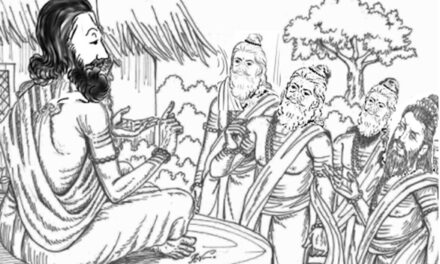
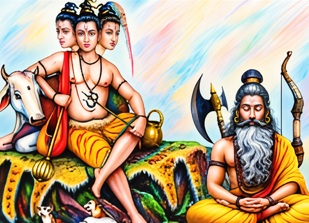
The text is traditionally associated with the era of the Ramayana, since King Janaka is regarded as a contemporary of that period. Yet, during my study of the Tripura Rahasya, I came across a reference that led me to reflect more deeply on this subject. The Tripura Rahasya, a text belonging to the post-Vedic period, contains a discourse in which Lord Dattathreya imparts spiritual wisdom to Lord Parashurama. In this discourse, there is a mention of the sage Ashtavakra receiving atma-bodha (knowledge of the Self) from King Janaka.
This reference raised an interesting possibility in my mind. If the Ashtavakra and Janaka of the Ashtavakra Gita belonged to the Ramayana era, could the personalities mentioned in the Tripura Rahasya have lived in a later period? Perhaps they were successors who bore the same names and carried forward the spiritual wisdom and traditions of their illustrious predecessors.
Once completed this book, I felt as though I had accomplished something truly significant. Deep within, I sense that the journey of my life is gradually approaching its culmination, and I was quite certain that I may never again undertake the writing of another book of this nature. There is, however, a profound sense of fulfilment in having completed this one. I thought I will put an end to my writing with completion of Tripura Rahasya, but Lord Dattathreya did not allow me to end my writing.
After few months of rest, I was again approached by an unknown Lord Datta devotee namely Dr. Anurag Gumashta of Baroda to do a Tamil version of Sri Datta Mahathmiyam originally written in Sanskrit language by Shri Vasudevanand Saraswati Tembe Swami Maharaj in the year 1901. Not rested with it, Dr. Anurag Gumashta got me permission from Sri Sadguru Seva Mandal, Mauritius to translate their English version of Shri Datta Charithra into Tamil language and publish it in my website. I though with its publication I would rest my writing. I did not pen any article after publishing in June 2026.
Tripura Rahasya is a profound spiritual text that elucidates the teachings of the highest spiritual truth. Traditionally, it is believed to comprise of three parts, of which only the first two are presently available, while the third according to the scholars, remains unavailable or undiscovered. According to tradition, the sacred teachings in this text were first imparted by Lord Shiva to Lord Vishnu, who subsequently transmitted them to Lord Brahma. It is believed that in later period of time, when Lord Vishnu incarnated on earth as the Avadhuta Dattathreya, he imparted this wisdom to Lord Parashurama. Lord Parashurama, in turn, reportedly passed it on to the sage Haritayana, who eventually shared it with the sage Narada.
Fate did not allow me to give rest to my writing. My life was suddenly and devastatingly jolted when my beloved wife passed away on 19 October 2026. Her departure left me feeling utterly orphaned, as though the very foundation of my life had been shaken. I was at a loss, unable to imagine how I would spend the rest of my life without her companionship. Even while the thirteen-day mourning rituals were still underway, some of my well-wishers, who called on me to offer their condolences and comfort, would invariably conclude their conversations with a piece of advice that I must continue writing. They suggested that immersing myself in writing might help divert my mind from the overwhelming sense of loss caused by the departure of my beloved wife.
I listened to their advice in good spirit, without expressing any reservations or sharing my own thoughts on the matter. However, I was not inclined to take up writing merely as a means of distraction. Then, quite suddenly, I arrived at a decision. I would channel my thoughts and energies into a pursuit that was both intellectually engaging and spiritually meaningful. I decided to translate the Tamil version of Tripura Rahasya into English and publish it on my website very soon.
Having made up my mind, I lost no time in embarking upon the task. Thus began my English translation of Tripura Rahasya—not merely as an occupation to keep myself engaged, but as a meaningful intellectual and spiritual undertaking that gave a new direction to my thoughts and energies during one of the most difficult phases of my life.
Finally read this exceptionally beautiful poem that deeply moved me.
As I wandered through this world,
I cradled countless dreams within my heart.
Yet I never allowed my spirit to crumble,
even when not one of them came to fruition.
Though life continued to withhold
all that I had yearned for,
my heart never surrendered to weariness.
Perhaps it was because, long ago,
it had learnt to make peace
with the emptiness within.
And is there not a beauty of its own
in such an existence?
A life in which so little comes to pass,
a life that appears hollow and unfulfilled,
like a glass left empty.
Is it not much like the gentle breeze
that brushes past us,
carrying away every fragrance
without leaving a trace?
Perhaps that is why,
at long last, I have learnt
to embrace life as it comes
and savour all that it has to offer—
its joys and sorrows,
its silences and uncertainties,
its fulfilled hopes and shattered dreams,
and even its disappointments.
For, in the end,
is there not a quiet fulfilment
in accepting life
without demanding that it fulfill us?
-‘’A Wayfarer’s Poem’’-
-SANTHIPRIYA